This Site is Sponsored By : Christopher's Book Room
(specializing in Books on the Middle Ages)
And is Hosted by the remarkable Ariadne's Thread.
Nota Bene: The new material herein is under Copyright.]

  The scholarly literature on the Royal Portal of Chartres cathedral is quite immense, and some considerable percentage (albeit certainly a minority) of it relates to the complex questions of the various styles –several of them– which are manifested on the hundreds of figures to be found on these three portals.
  This intense interest in the styles of the figures on these portals is surely to be explained by the immense influence which the Chartres portals seem to have had on (presumably) later portals to be found throughout Northern France.
  However, to my knowledge, there has been very little written about the question of the nature of the stylistic milieu into which these sculptures were, as we might say, interjected.
  That is : what sort of figure style(s) existed in the pre-Royal Portal Chartres of the late eleventh and early twelfth centuries?
   As it happens, this turns out to be a devilishly difficult question to broach, mainly because of a rather severe lack of surviving monuments and examples, to say nothing of the haphazard nature of the survial of these monuments (the full extent of which we may only understand through conjecture).
  We must assume, however, that, while there might have been a paucity of, say, stone sculpture in the region (an hypothesis which is by no means sure), there certainly was not any scarcity of figurative works in other media : painting, especially, given the richness and quality of 12th and 13th century surviving examples; but all other media must also be considered as having disappeared without, literally, a trace : sculpture in wood, ivory, stuccco, metal, etc., to say nothing of manuscript illumination, which surely existed in considerably a greater quantity than we have today (or even pre-1945).
  Therefore, the pitifully few surviving examples of figure style which we have from this period must be considered to be only the very faintest survivals and echoes of what originally existed, in whatever medium.
  So, what are these survivals, pitiful or no ?


Eleventh and twelfth century illuminated manuscripts from the Chartrain region are quite remarkably scarce, and it is difficult to say whether or not this is because scriptoria capable of producing them were virtually nonexistant (improbable), or because the region lacked, for some unfathomable reason, a tradition of illumination (also improbable), or because the manuscripts which were produced in this period have suffered from an unusual series of "accidental" destructions and simply have not survived.
 None of these options are particularly appealing, but the last seems the most probable, as the diocese certainly did not suffer from any lack of significant, well-endowed moastic houses, both secular and regular, any of which surely were capable of producing such artifacts.


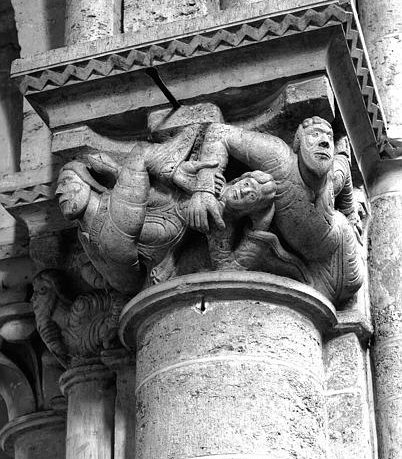
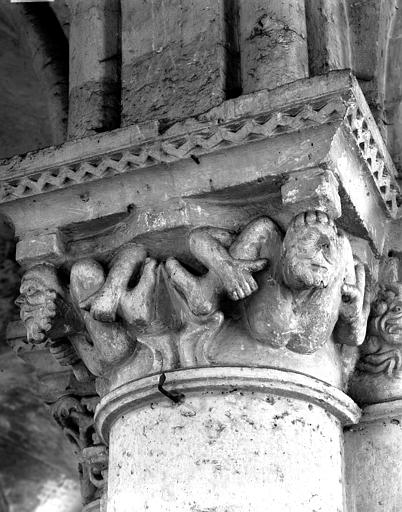
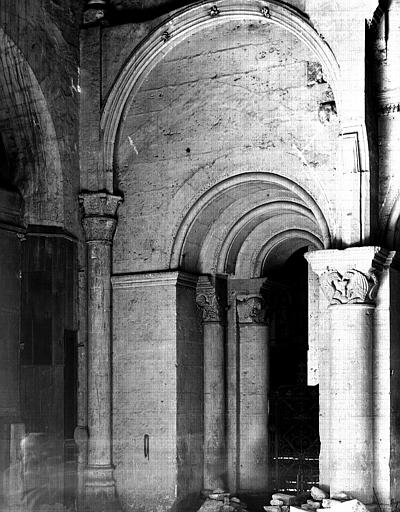
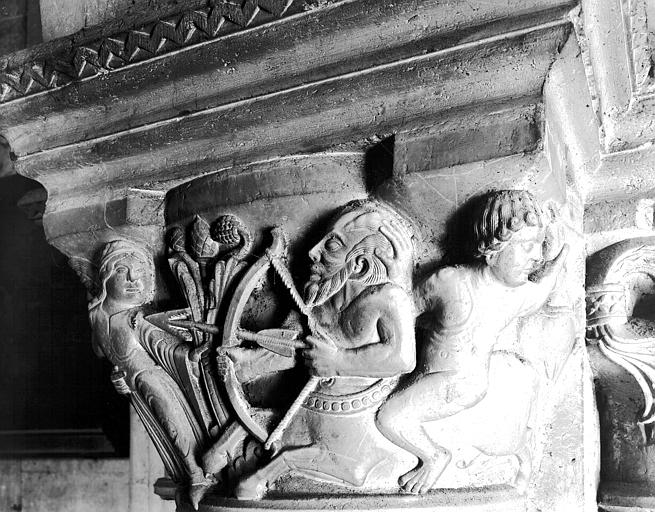
  In the Cathedral itself, as far as sculpture in stone is concerned, we have only the capitals to be found on the lowest level of the South side of the North Tower (presumably constructed shortly after the fire of 1134, though it could well be earlier –or later– than that).


  There are two capitals in this tower which have examples of (human) figurative sculpture, and the style shows every indication of being both sophisticated in conception and competent in execution (and, thus, imples the existance of at least one very, very accomplished workshop of stone sculptors working in this region at this time). Indeed, these capitals are among the most accomplished which may be found in France at this period.
   The style of these well-executed figures has the clarity of vision and the precision of realisation of that vision which suggests an accomplished Master, probably accompanied by a well-organised workshop.
(A further discussion of these capitals may be found here.)


3


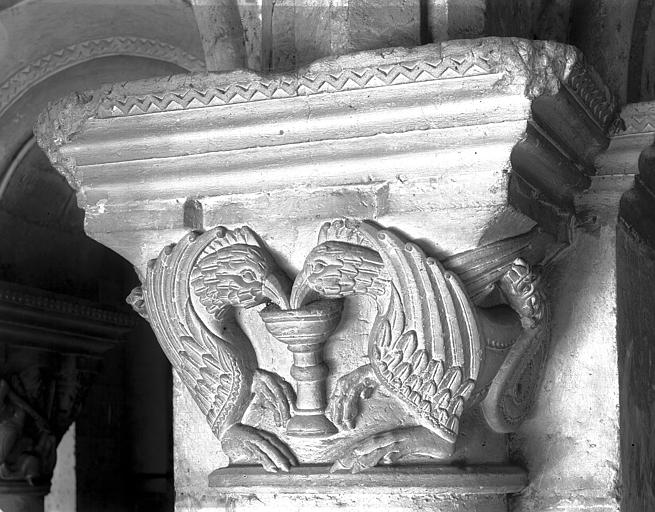
  The abbey of Saint Lomer in Blois was the most important ecclesiastical institution in that important city on the Loire (which did not become the seat of a bishopric until 1694).
  The quite large abbey church, which has never been properly analyzed architecturally, has a great many things to tell us about the earliest parts of the North tower of Chartres cathedral, whether it predates or is later that the latter.
Among the many, mostly foliate, capitals are a few which have human figures on them and are, thus, of interest in the present context.


R
ather close in figure style to these Chartres examples are stone sculptures from two other sites from an outlying (extreme North West) provence of the diocese which appear to be precious surviving evidence of, perhaps, a provincial style.
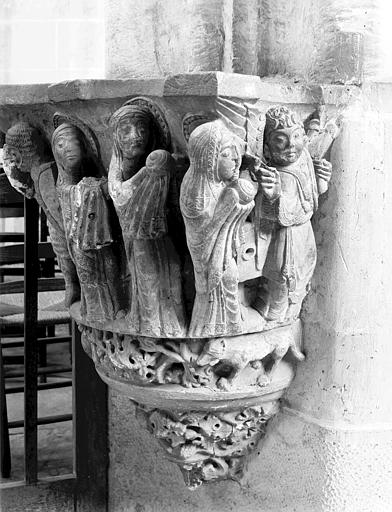
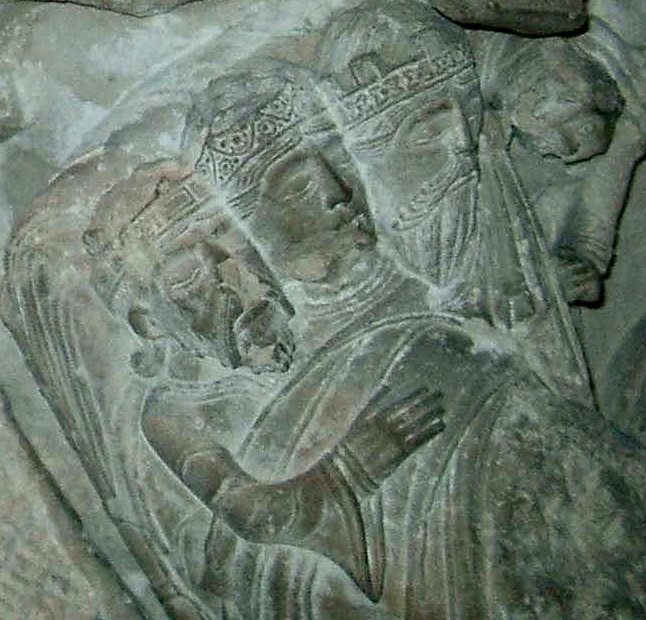
 The first of these is a capital from the church of St. Stephen of Dreux, now surviving as a bénétier.


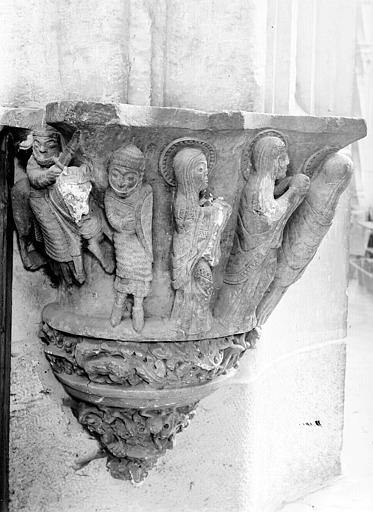
  The Benedictine abbey of Coulombs, just outside the important castrum of Nogent-le-Roi, in the Northwest corner of the diocese, is not far from Dreux, and from this important institution there survive two quite remarkable (and unique) double, "twisted" columns, perhaps from the abbey's cloister, which are now in the Louvre. These columns (from the cloister of the abbey?) contain figures on both the body of the columns and in the capitals above them.
Stylistically, the figures on these columns display a very close relationship to both our Dreux example and to those from the Chartres North tower.


North Tower caps
Mss
Blois caps
Coulombs
Dreux
L'Ile-Bouchard
Dangeau portal
Vendome ms(s)?
Angers mss (?)
Etampes Nave
St. Germain-des-Pres
St. Denis
Chateaudun-N. facade
Etampes

© NOTICE: The new contents of this page (errors and all) are
Copyright © Christopher Crockett, 2002.
Any commercial-free use for educational purposes is hereby authorized,
though I would appreciate hearing of the use to which my work is being put
(please write me informing me of such:: bccrockett@usa.net ).
T
he right to Any commercial use (uncluding publication in any vehicle which is sold)
is dependant upon Explicit, Written Permission, obtainable from the above

Please note that this site is

cortex

And is maintained by
Christopher Crockett
(who absolutely cannot be held
responsible if the above condition is not
rigorously adhered to).

Your input, comments and even (mild, gentle) criticisms 
are welcome and solicited.
Write me at:
bccrockett@usa.net

And with special thanks to Susan R. Dixon,
Creatrice of


S
pecializing in :

Web Designing with the goal of enabling organizations
to transform the way they create and interact with the world.

And sponsor of Medieval WebArtists, a cooperative project
providing server space for those working with any body of
scholarship about medieval art, history, literature, or life
that they wish to put on the web, an Ideal Home for Scholars
who have no academic affiliation and therefore little access
to stable accomodations for their work.

http://www.ariadne.org

Meanwhile, this Site is Definitely